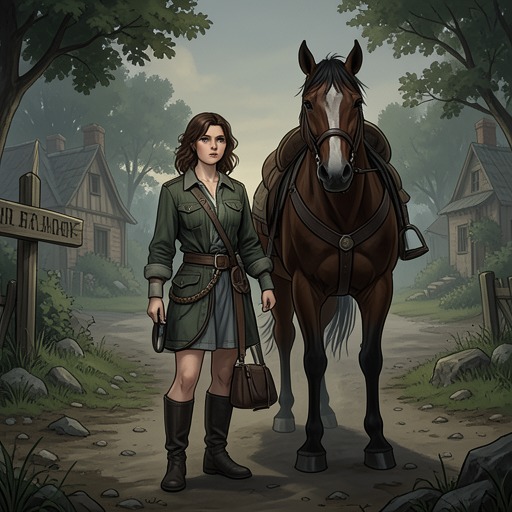
Talking Beasts
The Horse and His BoyTalking Beasts are speaking animals of Narnia, a community whose members can form friendships, share knowledge, make political decisions, and take part in war. Their speech makes visible a difference between life as persons among their own kind and life under human owners: Bree has spent years concealing his nature in Calormen, while his journey with Shasta and Hwin becomes a return toward the country and customs he remembers. The collective is not a single uniform group; its members have distinct abilities, temperaments, and degrees of readiness to act.
Identity and Narnian Life
Bree introduces Shasta to a world in which nearly all animals speak. He names Narnia as his homeland and describes it through its heathery mountains, thymy downs, rivers, glens, caverns, forests, and the sound of Dwarfs working. His praise contrasts an hour in Narnia with a thousand years in Calormen. For Bree, speech and belonging are inseparable from a remembered landscape and a free life among other speaking creatures.
Bree also explains that he was captured as a foal after wandering beyond the Southern slopes, despite his mother’s warning. He has since lived as a slave to humans, hiding his identity and pretending to be an ordinary, witless horse. His account establishes that apparent silence does not mean an absence of thought or selfhood: it is a concealment imposed by the circumstances of his captivity. His recollection of his mother’s warning also gives his history a family connection, while his regret identifies his own youthful disobedience as the circumstance that preceded his capture.
The horses’ Narnian connections are specific and social. After the escapees reach water, Bree and Hwin recognize that they remember the same places, including the grasslands above Beaversdam, and discover that they are distant cousins. Their kinship and shared memories give the horses a relationship independent of the children they accompany. The horses’ comfortable conversation, set against Shasta’s sulking and awkward attempt at grand manners, also makes the humans—not the animals—the socially ill-at-ease members of the party.
Speech, Agency, and Escape
The escape is explicitly shared. When Aravis treats the flight as her own and Shasta’s, Hwin objects that it is hers as well; she and Bree are trying to reach Narnia too. Hwin refuses to be treated as an accessory to a human plan, and Bree independently judges the people around him, recognizing both Shasta’s attempted escape and Aravis’s disguise. His teasing inference shows a speaker able to interpret human behavior and answer it on his own terms.
The group’s cooperation does not erase disagreements or differences in standing. Bree’s account of enslavement contrasts with the children’s circumstances, while Hwin insists that the horses’ own desire for escape belongs in the conversation. The horses are participants with a destination, histories, and judgments, not merely transportation. When the travelers stop after crossing the water, they unsaddle the horses, share food, and rest before exchanging stories; Bree takes the initiative in inviting Aravis to tell hers.
Their shared journey also exposes cultural assumptions that Bree must unlearn. In Narnia and Archenland, Talking Horses are not ordinarily ridden; the exception is wartime, when each does what that person can do best. Bree expects Aravis and Cor to mount the horses as they had before, and Cor’s explanation reminds him that he does not yet know the customs of the country he longs to reach. His subsequent self-consciousness registers the gap between yearning for home and being at ease within its social practices. Hwin, by contrast, strolls happily as they travel.
Knowledge and Public Responsibility
Speaking animals contribute knowledge that can affect the fate of kingdoms. Sallowpad the Raven has surveyed the desert in flight and explains that a large army cannot cross by the Great Oasis because its springs cannot supply enough water for all the soldiers and their beasts. He then describes another route: from the Tombs of the Ancient Kings, northwest toward the double peak of Mount Pire, and through a narrow stony valley to a river leading into Archenland. The information gives the Narnian council a concrete account of how an enemy might bypass the apparent desert barrier. It makes animal mobility and observation part of political and military understanding.
The warning matters because Rabadash intends to exploit precisely such a route. His plan is to take two hundred horsemen across the desert, reach Anvard before its defenders are prepared, then ride through the pass toward Narnia. Set beside Sallowpad’s geographical knowledge, the plan shows why the animals’ observations are not decorative lore: knowledge of water, terrain, and passage bears directly on the defense of Archenland and Narnia.
When Shasta carries the warning into the woods, the first response is broad agreement that something should be done, but not immediate action. Rabbits, a squirrel, magpies, a Faun, and a mouse gather and discuss the news; in the peaceful Golden Age under Peter the High King, the woodland creatures have grown somewhat careless. Duffle the Red Dwarf breaks through their indecision, insisting that word must reach Cair Paravel and that Narnia must aid King Lune. The scene distinguishes the ability to speak and share concern from the practical decision to organize a response, while showing that the smaller woodland people form a public community rather than an isolated collection of animals.
War and Collective Action
The force that arrives from Narnia makes its mixed composition unmistakable. Lord Peridan carries the red-lion banner; King Edmund and Queen Lucy ride at the head with Corin, followed by human soldiers, Talking Horses, centaurs, bears, Talking Dogs, and six giants. Talking Horses are ridden on this proper wartime occasion, a stated exception to the custom against mounting them. Their participation is thus framed as chosen service under exceptional circumstances, not as the ordinary right of humans to ride them.
The battle at Anvard gives the animals active roles in the defense. As the Narnians approach, the Calormenes turn from their assault on the castle gate to meet them. The Hermit’s running account reports that the Cats attack the men operating the battering ram, that the ram is brought down, and that the Cats then return to the main battle. Later the Cats attack from one side as the giants close in from the other and King Lune’s force presses from behind. These reports place animal combatants within a coordinated action that contributes to breaking the siege and defeating the invading army.
The outcome is a Narnian and Archenland victory: the Calormenes are defeated, surviving opponents are prisoners or surrender, and the castle gates stand open. The animals’ involvement belongs to a wider alliance in which human rulers, soldiers, and nonhuman peoples each contribute different capacities. Their place in the army is not merely symbolic; the narrative assigns them concrete functions in the battle’s course.
Customs, Relationships, and Return
Bree’s return to Narnia does not instantly resolve his sense of displacement. After the battle, he is subdued, and his unfamiliarity with local custom makes him increasingly nervous as he travels with Hwin. Cor reassures him that it is the human boy who faces a demanding course of education in reading, writing, heraldry, dancing, history, and music; Bree, by contrast, can expect to gallop and roll on Narnian hills. The contrast gently reverses the idea that the horse is the one who must be trained: in Narnia, human learning is named as a discipline, while Bree’s own way of life is not treated as a deficiency.
Bree and Hwin eventually live to a great age in Narnia, and each marries, though not the other. They regularly cross the pass to visit their friends at Anvard. Their ending extends their relationships beyond the escape and battle: they have independent lives and partners, yet maintain continuing friendship with the people they met on the road.
Across the story, Talking Beasts are shown through speech, memory, kinship, expertise, custom, and action. Bree’s forced performance of dumbness makes the difference between being an animal and being treated as property especially clear; Hwin’s insistence on her own stake in escape directly contests that treatment. Sallowpad’s knowledge, the woodland creatures’ deliberation, and the battle roles of the Cats and Talking Horses widen that account from individual freedom to collective participation. Narnia’s distinctive order is represented not simply by animals that can talk, but by a society in which their words, histories, and contributions have consequence.